
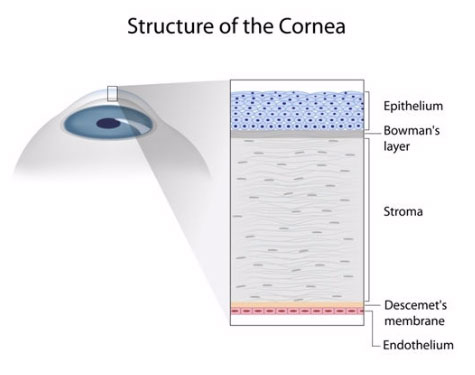
Goals of surgery
- Improve vision
- A small number of patients may have this procedure to reduce pain
Advantages of DMEK surgery
- Greater improvement in vision
- Better quality of vision
- Quicker recovery
- Less chance of rejection
- Minimal stitches
Risks of Endothelial Keratoplasty Rare but serious complications
- light-threatening infection inside the eye (1 in 1000)
- Severe haemorrhage causing loss of vision
- Retinal detachment
- Acute glaucoma causing loss of vision
Corneal transplant rejection
A corneal transplant can be identified and attacked by the patient’s immune system. This happens in only 1 in 30 patients in the first 2 years after transplantation but can cause graft failure. It is important to recognize the symptoms of rejection early so anti-rejection medication can be started as soon as possible.
Symptoms of rejection are:
- Red eye
- Sensitivity to light
- Reduced vision
- Mild pain
If you experience any of these symptoms you should contact Dr Green’s clinic immediately.
Graft Failure
When a graft fails the cornea becomes cloudy again and vision becomes blurred.
Glaucoma
Chronic mild glaucoma occurs in a small number of patients (approximately 4%). It is usually controlled by eyedrops but occasionally requires surgery.
Graft detachment
Partial detachment of DMEK grafts occurs in approximately 30% of cases and these patients need to have a second injection of air.
Complete detachment occurs in approximately 10% of patients and this is generally repaired in theatre with a repeat corneal graft.
The operation
The operation is day surgery performed under local anaesthetic and takes about one hour. Some patients need a cataract operation at the same time. Through a small incision the patients’ endothelium is removed and a thin sheet of donor endothelium is inserted and floated into position with a bubble of gas, which will remain present for a week.
Normal experiences after the operation
- You will need to lie flat for 1 hour after the operation.
- Its very important that you don’t fly in an aeroplane after the operation until the gas bubble is completely gone and this is confirmed by your doctor; this is usually two weeks
- Here will be a gradual improvement in vision over 4 weeks
- Mild amount of ocular discomfort and visible bleeding around the eye
- You will be examined by Dr Green after the surgery and can go home the same day.
- You will be seen a few days after the operation and again a week later to make sure the graft stays in position.
- You will have about 6 visits to the outpatient clinic in the first year.
- We generally recommend that you take 2 weeks off work – discuss your case with your doctor.
- You will need to use anti-rejection eyedrops for at least 6 months and in some cases indefinitely.